By the EV.Careers team. May 2026.
If you build batteries, work on batteries, or hire people who build batteries, the next 18 months in the U.S. are going to play out almost entirely in three states.
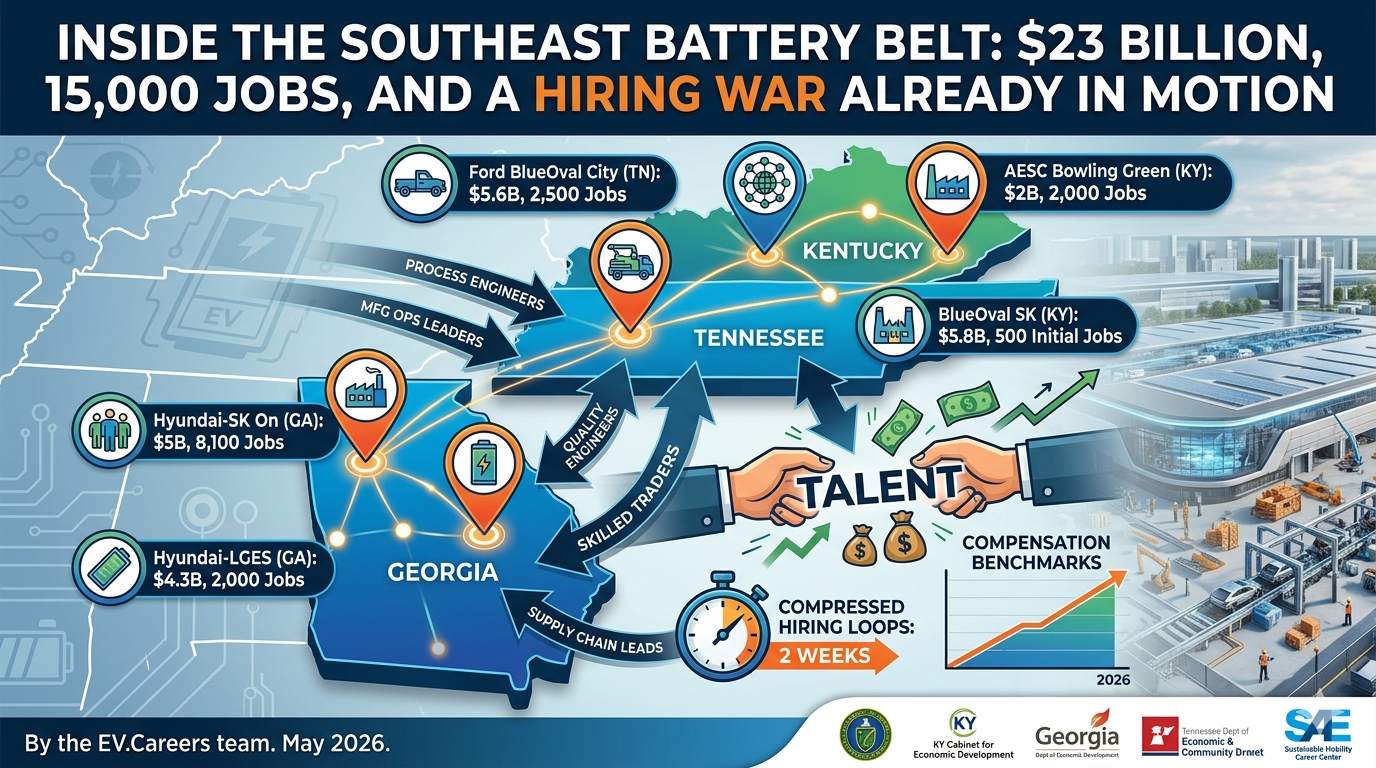
Georgia, Tennessee, and Kentucky together account for five major gigafactory projects representing roughly $23 billion in announced investment and more than 15,000 projected jobs. DOE analyses and broader industry investment trends point to the Southeast as one of the fastest-growing battery manufacturing corridors in the U.S. Most of these facilities have reached first production recently or will in 2026.
While major battery investments are also expanding in the Carolinas, Michigan, Kansas, and Arizona, the Georgia–Tennessee–Kentucky corridor currently represents one of the densest concentrations of battery manufacturing activity in the country.
The headlines are the projects. The story underneath is the hiring war they have already started.
Here is what we are watching, factory by factory.
Hyundai-SK On, Bartow County, Georgia
The largest of the cluster by both dollar commitment and headcount. A $5 billion joint venture between Hyundai Motor Group and SK On, with production beginning last year and part of a broader Hyundai EV manufacturing ecosystem expected to support more than 8,000 regional jobs.
Bartow County sits roughly an hour northwest of Atlanta, near Hyundai's Metaplant assembly site in Bryan County and the LGES joint venture in Savannah. The Atlanta-to-Savannah corridor is becoming the densest battery-manufacturing geography in the country.
Ford BlueOval City, Stanton, Tennessee
A $5.6 billion mega-campus that combines battery cell manufacturing with EV truck assembly. About 2,500 announced jobs across the battery side, with production starting in 2025.
Stanton is rural, which means the hiring story is partly a relocation story. Ford and its partners have been working with community colleges and the State of Tennessee to build a skilled-trades pipeline from scratch.
AESC Bowling Green, Kentucky
A $2 billion project announced in partnership with the State of Kentucky, with 2,000 new jobs and production starting in 2026. AESC (formerly Envision AESC) supplies cells to Mercedes-Benz, BMW, Nissan, and others, and Bowling Green is part of a larger U.S. footprint expansion that includes Florence, South Carolina.
Hyundai-LGES, Savannah, Georgia
A $4.3 billion battery joint venture between Hyundai Motor Group and LG Energy Solution, with 2,000 announced jobs and production starting in 2025. This facility supplies the Hyundai Metaplant on the same campus, making Savannah the most vertically-integrated EV-manufacturing site in the Southeast.
BlueOval SK, Glendale, Kentucky
Two battery factories in one campus, jointly operated by Ford and SK On. A $5.8 billion combined investment, with the first phase expected to create thousands of jobs across multiple production phases. The campus is designed to power 1.3 million electric vehicles per year by 2026.
What This Means for Hiring
A few patterns are already clear from our pipeline conversations across these projects.
First, the talent pull is regional, not just local. These five projects are recruiting from the same labor pool: process engineers with prior battery-manufacturing experience, manufacturing operations leaders, quality engineers, maintenance and skilled trades, and supply-chain leads with high-volume electronics backgrounds. The candidates with the strongest profiles are receiving multiple offers, and we are seeing time-to-decision compress to under two weeks for senior IC roles and under four weeks for leadership.
Second, the comp ceilings are moving. Process-engineering comp in the Southeast has lifted noticeably over the past 18 months based on our placements, with the steepest increases at the manager-of-managers level where supply is thinnest. Any hiring plan built off 2024 benchmarks needs to be re-benchmarked before it goes to offer.
Third, the relocation play is harder than it looks. Several of these sites are rural or semi-rural, with limited housing inventory and uneven school options. Candidates from Detroit, the Bay Area, or Boston are not always an easy "yes" even at a premium comp. The teams winning here are the ones with structured relocation support, partner-employment programs for spouses, and a real recruiting story about the region's future.
What It Means If You Hire Outside the Southeast
You are competing for the same talent, whether you intended to be or not. A battery-pack engineer in Detroit can have a Hyundai-SK On offer by the end of the week. A process-engineering leader in Boston can be on the ground in Savannah for an on-site within ten days. If your hiring cycle is four to six weeks and you assume "candidates are interviewing elsewhere" without a real read on with whom, you are losing offers you did not realize were ever competitive.
Three plays we are watching work in the current market:
- Compress your interview loop. Two-week loops are winning. Three-week loops are losing.
- Lead with the work. Senior battery talent is choosing problems, not logos. If your roadmap and engineering culture do not come through in the first conversation, you are out by the second.
- Re-benchmark comp. The 2024 numbers do not hold. Pull fresh comp data for any open battery req before you go to offer.
How We Are Positioned for This
EV.Careers has spent the last four years building the largest opt-in candidate database in the EV sector, with deep coverage across battery-manufacturing engineering, charging infrastructure, BESS, and powertrain. Our EV Talent on Demand service is built for exactly this market: pre-screened candidates in 5 to 7 days, project-based or contract-to-hire, with payroll, compliance, and invoicing handled.
If you are hiring into the Southeast battery belt or anywhere else in the U.S. and starting to feel the talent pull from it, we should talk.
Tell us what you need at ev.careers/talent-on-demand. We will come back within 24 hours.
Sources: U.S. Department of Energy, Kentucky Cabinet for Economic Development, Georgia Department of Economic Development, Tennessee Department of Economic and Community Development, SAE Sustainable Mobility Career Center, Manufacturing Dive.


